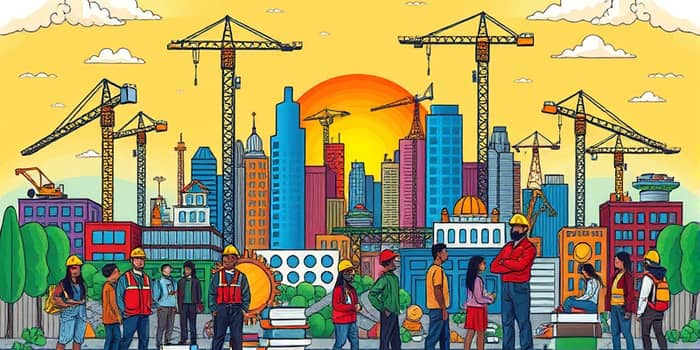
Every nation’s journey toward prosperity begins with a single step: building the resources to produce, innovate, and improve lives. Increasing the stock of physical capital and nurturing human potential are the cornerstones of sustainable advancement. This article will illuminate the path from concept to practice, guiding you to harness capital formation as a powerful engine of growth.
Understanding Capital Formation: The Foundation of Prosperity
At its core, capital formation is the process by which societies accumulate and deploy assets—machinery, infrastructure, skills, and knowledge—to raise output and welfare. Measured as gross fixed capital formation or net additions after depreciation, this process lays the groundwork for every leap in productivity.
Imagine a village with modern irrigation pumps, a skilled workforce, and reliable roads. Each component represents an element of capital: physical equipment, human expertise, and essential infrastructure. Together they form a virtuous cycle, where better tools lead to higher yields, increased savings, and further investment.
How Capital Formation Drives Economic Growth
Economic theories converge on one truth: investment in capital expands capacity and output. The neoclassical view emphasizes the higher capital-labor ratio, where each worker, equipped with superior tools, produces more. However, diminishing marginal returns eventually temper growth unless offset by innovation and skill development.
Endogenous growth theory extends the concept, asserting that human capital and knowledge capital—education, health, research—generate self-reinforcing progress. In this view, a well-trained workforce and continuous innovation sustain growth rates indefinitely.
Institutional quality also matters. Strong governance, transparent regulation, and fair property enforcement create an environment where investments thrive. Without these pillars, even abundant resources may lie idle or be misused.
Practical Strategies to Enhance Capital Formation
Translating theory into action requires deliberate policies and community engagement. The following strategies can help governments, businesses, and citizens accelerate capital accumulation:
- Promote savings through incentives, ensuring stable funding for long-term projects.
- Channel public spending into high-impact infrastructure: roads, power, and digital networks.
- Support small and medium enterprises with accessible credit and training programs.
- Invest in education and vocational training to build a resilient workforce.
- Encourage research and development by offering grants, tax breaks, and collaborative platforms.
- Strengthen institutions: enforce contracts, protect property rights, and combat corruption.
Communities can also create local investment funds or cooperatives, pooling resources for projects that deliver broad benefits—from solar installations to community clinics. By fostering participation, these initiatives build both social capital and tangible assets.
Measuring Success: Key Indicators and Metrics
To gauge progress, policymakers and analysts track several core metrics. Understanding these indicators helps prioritize resources and fine-tune strategies for maximum impact.
Regularly monitoring these figures allows leaders to spot trends—whether investment is accelerating, stagnating, or shifting into low-productivity areas. When growth falters, adjustments can be made swiftly to revive momentum.
Lessons from Transformation: Global Case Studies
History offers vivid examples of capital-driven metamorphosis. In the last half-century, two Asian economies stand out:
China’s investment-driven miracle saw gross capital formation soar to nearly 40% of GDP. By channeling high savings into infrastructure, manufacturing, and urban expansion—while gradually reforming institutions—China lifted hundreds of millions out of poverty and became a global leader in exports.
South Korea’s strategic ascent combined disciplined savings policies with an export-focused industrial strategy. Emphasizing education, R&D, and targeted support for electronics and automotive champions, the nation transformed from a low-income agrarian society into a high-tech powerhouse in just a few decades.
These stories share common threads: visionary leadership, clear policy targets, and unwavering commitment to both physical and human capital. Most importantly, they remind us that no country is destined to remain poor if it marshals its resources wisely.
Overcoming Challenges and Charting the Future
No journey is without obstacles. Diminishing returns may set in if investment quality lags, or environmental costs mount under unchecked expansion. Rapid population growth can dilute gains unless met with parallel advances in health, education, and family planning.
To ensure sustainable progress, stakeholders must balance ambition with responsibility. This means integrating green technologies, prioritizing maintenance, and fostering innovation ecosystems where new ideas flourish. It also calls for social inclusion, ensuring that the benefits of growth reach every citizen.
Capital formation is more than an economic indicator; it’s a collective vision of what we can build together. By investing in machines, roads, schools, and ideas, we lay the foundation for higher incomes, better health, and more fulfilling lives. The challenge now is to act—with urgency, wisdom, and unity.
Whether you are a policymaker, entrepreneur, or engaged citizen, you hold a piece of this grand puzzle. Identify opportunities in your community, advocate for sound policies, and invest your time and resources where they matter most. Together, we can transform ambition into action, and action into prosperity for generations to come.
References
- https://fiveable.me/key-terms/principles-econ/capital-formation
- https://fastercapital.com/topics/the-relationship-between-capital-formation-and-economic-growth.html/1
- https://rreconomic.ru/en/journal/article/3562/
- https://www.tutorocean.com/questions-answers/what-are-the-main-sources-of-capital-formation
- https://en.wikipedia.org/wiki/Capital_formation
- https://www.jstor.org/stable/1815471
- https://databank.worldbank.org/metadataglossary/world-development-indicators/series/NE.GDI.TOTL.ZS