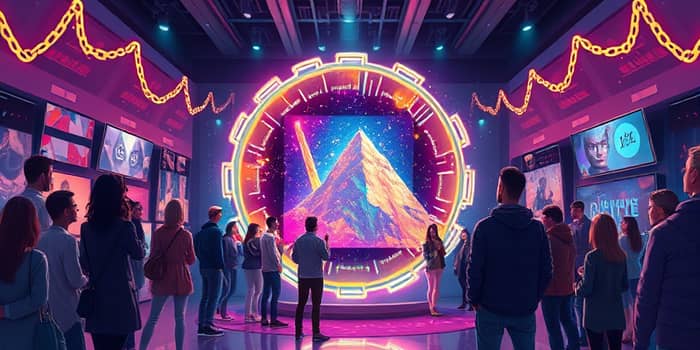
The digital art world is undergoing a profound transformation as blockchain technology converges with creative innovation. What once existed as intangible pixels is now evolving into valuable assets, reshaping how art is created, bought, and sold. This revolution promises to democratize access, empower artists, and redefine the concept of ownership in an interconnected global marketplace.
The Digital Art Landscape: Growth and Momentum
The global digital art market was valued at USD 6.65 billion in 2026 and is projected to reach USD 30.69 billion by 2035 at a remarkable 15.53% CAGR. Within this broader ecosystem, blockchain-based segments are outpacing traditional channels, growing at nearly double the rate of traditional digital art. Crypto art alone, valued at USD 2.66 billion in 2026, is forecast to surge to USD 14.77 billion by 2035 at a 21% CAGR, illustrating robust investor appetite.
Meanwhile, on-chain assets are set to surpass USD 5.63 billion by 2031, growing at a 17.45% CAGR. The NFT-as-a-Service market, currently at USD 3.62 billion, is poised for exponential expansion. These figures underscore a shift toward decentralized, trustless systems that reduce intermediaries and empower creators directly.
Key Drivers of Growth
Several factors are fueling the rapid ascent of blockchain-powered art. Generative AI tools enhance creative capacity and accelerate production timelines. A growing cohort of digital-native collectors, particularly in Asia-Pacific, seeks transparent and verifiable ownership records. Meanwhile, high-profile investments by celebrities and institutions lend credibility and attract fresh capital. Finally, smart contract–enabled royalty structures ensure artists receive ongoing compensation for secondary sales.
- Generative AI boosting content creation
- Digital-native buyers propelling demand
- Celebrity and institutional investment
- Blockchain-based royalty contracts
Blockchain’s Transformative Power
Authenticity and provenance, long-standing challenges in the art world, are addressed through a secure and transparent system for recording every transaction on an immutable ledger. Collectors can now verify the origin and history of a work with confidence.
Smart contracts automate royalty payments, guaranteeing ongoing revenue streams for creators whenever their works are resold. This mechanism aligns incentives and fosters sustainable artistic careers.
Decentralized marketplaces allow artists to bypass traditional galleries and auction houses, connecting directly with buyers worldwide. While top platforms command significant volume, niche decentralized exchanges are emerging to offer curated experiences and lower fees.
The tokenization of artworks enables fractional ownership and accessibility for investors, breaking high-value works into more affordable shares. This innovation broadens participation and encourages collective investment strategies.
Regional and Demographic Shifts
North America leads the crypto art market, accounting for over 60% of transactions. Europe represents about 32% of sales, while Asia-Pacific is the fastest-growing region, driven by a digitally native population and rising disposable incomes. In the U.S. alone, the online art market is projected to grow from USD 3.28 billion in 2025 to USD 6.34 billion by 2035 at a 6.80% CAGR.
Collector motivations reveal that 65% are drawn by digital ownership, 48% value transparent transactions secured by blockchain, and 46% prefer fractional investment models. These preferences underscore a generational shift toward asset digitalization.
- 65% motivated by digital ownership
- 48% value blockchain security
- 46% prefer fractional ownership
Navigating Challenges and Looking Ahead
Despite its promise, the blockchain art market faces hurdles. Regulatory frameworks remain unsettled in many jurisdictions, creating uncertainty for participants. Environmental concerns persist, especially around energy-intensive proof-of-work networks, though the shift to proof-of-stake and eco-friendly blockchains is underway. Legal issues around copyright and digital rights management also require ongoing clarity. Finally, cryptocurrency price volatility can impact valuations and buyer confidence.
Emerging solutions are already taking shape. The formation of licensed data cooperatives for ethical sourcing will secure high-quality training sets for generative art. Multichain infrastructure will reduce single-network dependencies and expand interoperability. Integration with augmented reality, virtual reality, and generative AI promises immersive experiences that blend physical and digital realms.
- Licensed data cooperatives for ethical sourcing
- Multichain marketplaces reducing reliance
- Integration with AR, VR and AI
As traditional institutions embrace NFT exhibitions and auction platforms integrate crypto bidding, the gap between conventional and digital-first art worlds narrows. Artists, collectors, and technologists share a common vision: a more inclusive, transparent, and dynamic creative economy.
For artists, this is a moment of unprecedented opportunity to claim ownership, expand their audience, and build sustainable revenue models. For collectors, it’s a chance to participate in an evolving market fueled by innovation and trust. The fusion of pixels with blockchain is not merely a trend—it’s a paradigm shift that invites every stakeholder to reimagine the art market’s future.
Together, we stand at the threshold of a new era where creativity and technology coalesce to unlock limitless possibilities. From pixels to profit, the canvas has never been broader.
References
- https://www.mordorintelligence.com/industry-reports/digital-art-market
- https://papers.ssrn.com/sol3/papers.cfm?abstract_id=4439318
- https://www.businessresearchinsights.com/market-reports/crypto-art-market-117368
- https://www.smu.edu/meadows/newsandevents/news/2024/blockchain-the-future-of-digital-art-and-design
- https://www.snsinsider.com/reports/online-art-market-8097
- https://artislife365.substack.com/p/the-impact-of-nfts-on-the-art-market
- https://www.rootsanalysis.com/digital-art-market
- https://auroraathena.com/journal/insights/art-market-2026-report/
- https://www.rwa.io/post/how-tokenization-is-disrupting-the-art-market
- https://colexion.io/nft/market-size-trends/
- https://www.artbasel.com/stories/digital-art-boom-gen-z-collectors?lang=en
- https://www.researchnester.com/reports/nft-as-a-service-market/7651