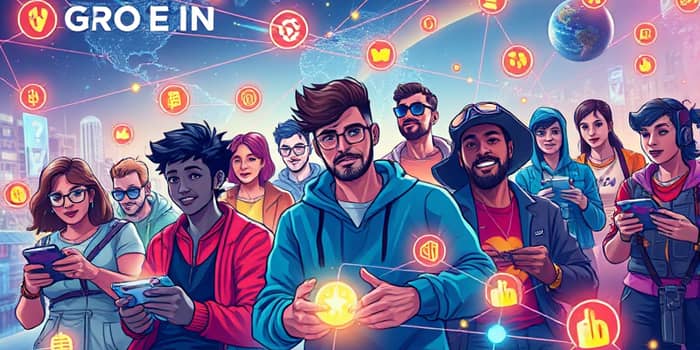
The gaming industry is experiencing a seismic shift as blockchain technology unlocks new possibilities for players, creators, and investors alike. The play-to-earn (P2E) model has ignited imaginations worldwide and promises to redefine digital ownership, community engagement, and value creation within virtual worlds.
From humble NFT experiments in 2022 to multi-billion-dollar forecasts by 2032, blockchain gaming has grown from a niche curiosity into a global phenomenon. This article explores the forces driving the P2E revolution, the obstacles that remain, and practical strategies for entrepreneurs, developers, and gamers to participate meaningfully in this thriving ecosystem.
Emergence of the P2E Paradigm
Just a few years ago, gaming was a closed loop: players invested time and money, but held no lasting equity in virtual worlds. Today, blockchain gaming introduces true ownership and trading of in-game assets. Non-fungible tokens (NFTs) serve as provable certificates of rarity and scarcity, enabling players to buy, sell, or lend digital items across decentralized marketplaces.
This shift is backed by remarkable metrics: daily unique active wallets soared to 5.8 million in early 2025, reflecting a resilient user base in spite of market volatility. Estimates for the global blockchain gaming market range from USD 73.56 billion in 2030 to nearly USD 943.85 billion by 2032, revealing both optimism and variance in forecasting methodologies.
Drivers Fueling Explosive Growth
Multiple factors converge to power the P2E revolution:
- Enhanced accessibility and fraud reduction: Blockchain’s cryptographic security builds trust and transparency in digital economies.
- Venture investments and innovation: Record funding rounds for studios, metaverse platforms, and Layer-2 scaling solutions.
- User-centric economies: Players earn tokens and NFTs simply by participating, aligning incentives between developers and communities.
Technological advances—such as interoperable NFTs, VR/AR integration, and decentralized multiplayer environments—are also expanding the horizon for gameplay experiences. By layering blockchain on familiar gaming genres like role-playing, strategy, and sports, developers cater to both casual players and hardcore enthusiasts.
Regional Powerhouses Shaping the Market
Blockchain gaming’s growth is not uniform across the globe. Regional dynamics shape user behavior, regulatory climates, and market potential.
Asia-Pacific leads the charge, driven by mobile gaming cultures in China, Japan, and South Korea. North America’s strong infrastructure and regulatory support foster innovation hubs in the United States. Europe balances enthusiasm with consumer protections, while emerging markets in Latin America and Africa present untapped potential for adoption.
Challenges on the Road Ahead
Despite promising growth, blockchain gaming faces significant hurdles. Limited public awareness of blockchain and NFTs still stifles widespread adoption. Integrating secure wallet experiences into mainstream games remains complex, and regulatory uncertainty around digital assets can inhibit investment.
Market volatility poses another challenge: wallet activity dipped by 6% QoQ in early 2025, underscoring the need for sustainable tokenomics and user education. Data privacy regulations and the environmental impact of certain blockchain protocols also demand innovative solutions and industry collaboration.
Seizing the Opportunities: A Guide for Innovators
For developers, entrepreneurs, and gamers eager to join the P2E revolution, the following strategies can help navigate the landscape:
- Design transparent tokenomics with clear reward models and burn mechanisms to stabilize value.
- Implement user-friendly wallets and onboarding processes to lower barriers to entry.
- Collaborate with cross-chain bridges and Layer-2 networks for faster, cheaper transactions.
- Engage communities through governance tokens and decentralized autonomous organizations (DAOs).
Applying frameworks like PESTEL analysis and Porter’s Five Forces can further refine market positioning. Conducting patent landscaping and lifecycle assessments ensures projects remain both innovative and compliant.
Building a Sustainable Future in Blockchain Gaming
The play-to-earn revolution offers a once-in-a-generation opportunity to reshape digital entertainment. By empowering players with ownership, fostering community-driven economies, and leveraging cutting-edge technologies, blockchain gaming can transcend the limitations of traditional models.
Stakeholders must collaborate transparently, prioritize user experience, and commit to long-term sustainability. As the industry matures, bridging the gap between Web2 and Web3 will be crucial—unlocking the full potential of immersive, decentralized worlds where creativity and commerce coexist harmoniously.
In this new era, every gamer, developer, and investor has a role to play. Together, we can write the next chapter of interactive entertainment—one where value is shared, communities flourish, and the boundaries of the possible are forever expanded.
References
- https://www.imarcgroup.com/united-states-blockchain-gaming-market
- https://www.360iresearch.com/library/intelligence/blockchain-gaming
- https://www.skyquestt.com/report/blockchain-gaming-market
- https://www.cognitivemarketresearch.com/blockchain-game-market-report
- https://www.marketsandmarkets.com/Market-Reports/blockchain-gaming-market-167926225.html
- https://www.thebusinessresearchcompany.com/report/blockchain-gaming-global-market-report
- https://vocal.media/futurism/blockchain-gaming-market-trends-interoperable-nf-ts-layer-2-scaling-and-industry-outlook-to-2033