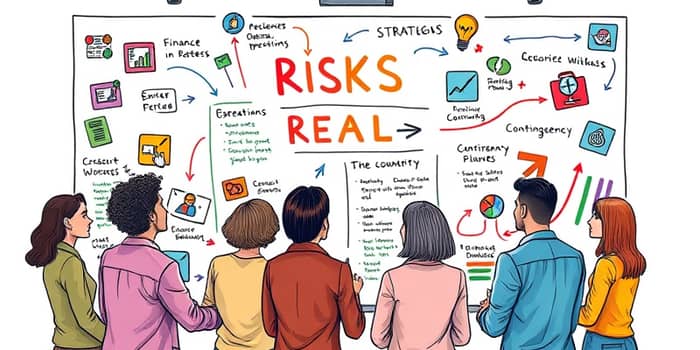
In today’s fast-paced world, uncertainty can either threaten progress or fuel innovation. By mastering risk management, organizations and individuals can transform uncertainty into strategic advantage and foster sustainable growth.
Building a Solid Risk Management Foundation
Effective risk management begins with a clear, repeatable framework. When you establish strong processes, you create space for creativity and bold decision-making without fear.
- Risk identification: Discover potential threats and opportunities.
- Risk analysis and assessment: Gauge likelihood and impact.
- Controls implementation: Design safeguards and policies.
- Resource and budget allocation: Secure funds and personnel.
- Mitigation: Execute measures to reduce risk exposure.
- Ongoing monitoring, review, and reporting: Track performance and adapt.
Maintaining a robust risk register with detailed entries ensures visibility of every hazard. Engage stakeholders—from executives to frontline employees—to align with organizational risk appetite and foster a culture of shared responsibility.
Primary Risk Treatment Strategies
Once risks are identified and assessed, choose the strategy that best balances cost, effort, and benefit. Four core approaches often expand to five when you include contingency planning.
Choosing among these requires understanding the risk’s nature, its potential impact, your team’s tolerance, and available resources. When applied thoughtfully, these strategies form the backbone of any successful risk program.
Advanced Risk Hedging Techniques
Beyond the fundamentals, innovative methods help you hedge bets more comprehensively. These techniques enable proactive adaptation and continuous learning.
- Business experiments: Run what-if scenarios to validate decisions.
- Minimum Viable Product (MVP) development: Launch core features first.
- Theory validation: Test critical assumptions before scaling.
- Isolating risks: Contain threats to specific processes or units.
- Building buffers: Add time and budget cushions for surprises.
- Data analysis and risk-reward review: Use metrics to guide priorities.
- Lessons learned and root cause analysis: Refine plans from past events.
- Leveraging best practices and frameworks: Adopt proven models like PMBOK.
- Investment-specific tactics: Diversification, stop-loss orders, position sizing.
These techniques, when combined, create a layered shield. By running controlled experiments before major investments, you can gather insights without jeopardizing core operations.
Effective Risk Assessment Methods
Assessment is the engine that powers every treatment strategy. Choose from qualitative, quantitative, or hybrid approaches to suit your project’s complexity and data availability.
Qualitative methods rely on expert judgment, workshops, and structured questionnaires to categorize risks into high, medium, or low tiers. These techniques excel when numerical data is scarce but domain knowledge is rich.
Quantitative methods employ statistical models, probability distributions, and numerical impact analysis. Ideal for financial portfolios or operations with measurable metrics, they produce precise estimates but demand reliable data.
A hybrid approach combines the strengths of both. Use qualitative insights to narrow down focus, then apply quantitative analysis for your most critical risks. This combine both qualitative and quantitative methods approach delivers a comprehensive landscape of potential challenges.
Crafting a Resilient Risk Management Plan
A thorough plan integrates processes, budgets, roles, and reporting structures. Key components include:
Defined tasks and processes ensure each step from identification to monitoring is clear. Allocate budgets aligned with risk severity, and assign responsibilities to owners empowered to act.
Maintain a dynamic risk register that logs every change in status, likelihood, and mitigation. Institute periodic status meetings and trigger-based updates so that dynamic monitoring and ongoing review become part of your culture.
Adopt a tiered mitigation hierarchy: address high-impact, high-likelihood risks first, then proceed to lower tiers. Include escalation paths and reporting hierarchies so that executive leadership stays informed and engaged.
Real-world Applications and Benefits
Organizations across industries leverage risk management to drive decisions, foster innovation, and safeguard assets. Examples include:
• Financial firms use stop-loss orders and diversification to protect portfolios from volatility.
• Tech companies implement pilot projects (MVPs) to validate ideas and contain budget overruns.
• Manufacturers maintain alternate suppliers and disaster plans to secure supply chains against disruptions.
By embedding risk frameworks into daily operations, teams become more agile and confident. Continuous assessment evolves with changing conditions, ensuring your strategy remains relevant as new threats emerge.
Embracing a Culture of Continuous Improvement
Risk management is not a one-time project—it’s a journey. Celebrate successes and review setbacks to refine your approach. Encourage open communication and knowledge sharing so that every stakeholder feels empowered to flag emerging issues.
Invest in training, workshops, and technology that enhance visibility and collaboration. When everyone understands that risk management is about seizing opportunities as much as it is about preventing losses, you cultivate a resilient, forward-thinking organization.
As you apply these principles, remember that the ultimate goal is not to eliminate all risk—it’s to navigate uncertainty with confidence and clarity. By hedging your bets wisely, you unlock the potential to innovate boldly and achieve lasting success.
References
- https://www.metricstream.com/learn/risk-management-strategies.html
- https://auditboard.com/blog/10-risk-management-strategies
- https://auditboard.com/blog/risk-management-101
- https://hyperproof.io/resource/risk-management-techniques/
- https://www.horizoninvestments.com/risk-management-strategies-professional-guide-to-investment-protection/
- https://www.piranirisk.com/blog/risk-management-strategies
- https://www.getbcs.com/blog/your-complete-guide-to-developing-an-effective-risk-management-plan
- https://www.zengrc.com/blog/common-risk-management-strategies-risk-avoidance-vs-risk-reduction/
- https://www.protechtgroup.com/en-us/blog/risk-management-101-a-complete-guide-to-business-resilience
- https://www.sba.gov/blog/5-best-risk-management-strategies
- https://www.pmi.org/learning/library/practical-risk-management-approach-8248
- https://online.hbs.edu/blog/post/risk-management
- https://www.sentinelone.com/cybersecurity-101/cybersecurity/risk-management-strategies/
- https://www.diligent.com/resources/blog/strategic-risk-examples
- https://www.ehsinsight.com/blog/a-comprehensive-guide-to-risk-assessment-and-management