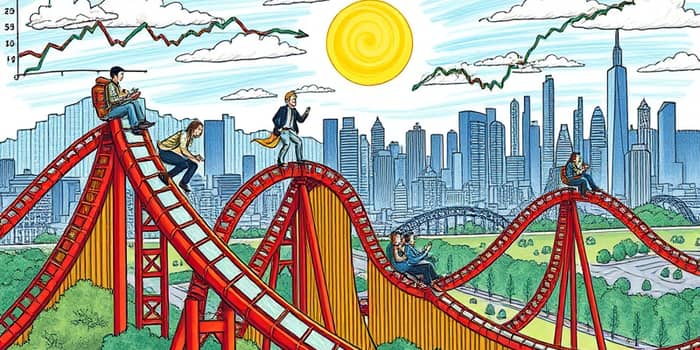
In today’s ever-shifting financial landscape, understanding market cycles is the difference between panic and profit, fear and confidence. By mastering these natural rhythms, investors can anticipate turning points, allocate resources wisely, and safeguard their portfolios.
Understanding Market Cycles
A market cycle represents the long-term pattern of rising and falling prices that unfolds as economies expand and contract. These cycles are shaped by a constellation of factors including economic growth, monetary policy, investor sentiment, and technological change. Recognizing that markets rarely move in a straight line, but instead progress through discernible phases, equips investors with the foresight to act strategically rather than react emotionally.
At its core, a cycle reflects the interplay between demand and supply dynamics. During periods of expansion, rising demand pushes asset prices higher, while contractions see demand wane, driving values downward.
The Four-Phase Cycle Framework
Financial experts often segment market activity into four distinct phases, each with unique characteristics and implications for investors.
- Early Cycle (Recovery): A sharp rebound from troughs in GDP and production, low interest rates, strong credit growth, and rebuilding inventories set the stage for growth.
- Mid-Cycle (Expansion): The longest and most sustainable phase, marked by healthy profitability, moderate growth, neutral monetary policy, and broad investor participation.
- Late Cycle (Peak): Growth peaks and slows, inflation rises, interest rates climb, and profit margins face pressure as markets near exhaustion.
- Recession (Contraction): Economic activity shrinks, corporate earnings decline, credit tightens, and market sentiment turns sharply negative.
From a technical perspective, these stages correspond to accumulation, markup, distribution, and markdown. Institutional "smart money" often accumulates positions quietly after a downturn, then sells to eager retail investors at the peak, only to watch prices decline during the markdown phase.
Investor Psychology Through the Cycle
Emotions drive market behavior as much as fundamentals. Understanding prevailing sentiment can help investors align their actions with where the cycle stands.
- Accumulation: Predominant feelings of fear and disbelief keep prices subdued.
- Markup: Sentiment shifts from hope to optimism and ultimately euphoria.
- Distribution: Complacency sets in as investors deny warning signs.
- Markdown: Anxiety turns to panic and capitulation as losses mount.
By observing shifts in volume, valuation metrics, and media tone, savvy investors can infer when sentiment extremes are near and prepare accordingly.
Asset Performance Across Phases
Not all asset classes respond equally to each cycle phase. Knowing which sectors tend to outperform or underperform can guide portfolio adjustments.
During early stages, cyclical sectors like industrials and consumer discretionary often outperform, while defensive sectors such as utilities and healthcare shine during downturns. Commodities can rally in inflationary peaks but suffer in contractions.
Strategies to Ride the Ups and Downs
Navigating cycles successfully requires discipline and a clear plan. Consider these practical approaches:
- Stay diversified across sectors and asset classes to reduce concentration risk.
- Rebalance at strategic intervals to lock in gains from outperformers and add to laggards in emerging phases.
- Use valuation metrics like P/E ratios and yield spreads to identify cycle extremes.
- Incorporate macro indicators—GDP growth, unemployment rates, central bank signals—into your decision framework.
- Maintain a cash or cash-equivalent buffer to capitalize on buying opportunities during markdown phases.
Rather than chasing performance, focus on consistent, systematic adjustments that align with where the cycle stands. This mitigates emotional decision-making and preserves capital when conditions deteriorate.
Building a Cycle-Aware Mindset
Beyond technical and fundamental analysis, cultivating the right mindset is paramount. Embrace the idea that markets are inherently cyclical. Prepare mentally for downturns as inevitable pauses in the growth story rather than catastrophic anomalies.
Keep a journal of your decisions and the rationale behind them. Over time, this record will reveal patterns in your own behavior—insights you can use to fine-tune your approach and stay objective.
Conclusion: Embracing the Rhythm of Markets
Market cycles will continue to rise and fall, propelled by shifts in economics, policy, technology, and sentiment. Rather than fearing downturns or chasing euphoric peaks, investors who master these cycles can turn volatility into opportunity.
By understanding each phase’s defining traits, aligning psychology with market mood, and employing disciplined strategies, you’ll be poised to capitalize on cyclical shifts and protect your portfolio when storms arise. Embrace the ride, stay informed, and let the rhythm of the market guide your journey to long-term success.
References
- https://www.heygotrade.com/en/blog/mastering-market-cycle-investing-approach
- https://www.fidelity.com/viewpoints/investing-ideas/sector-investing-business-cycle
- https://foolwealth.com/insights/four-stages-of-the-stock-market-cycle
- https://www.oanda.com/us-en/trade-tap-blog/trading-knowledge/market-cycles-key-indicators-guide/
- https://www.poems.com.sg/glossary/investment/market-cycle/
- https://www.truedata.in/blog/market-cycles-and-their-impact-on-stock-fundamentals
- https://www.schwab.com/learn/story/four-stages-stock-market-cycles
- https://corporatefinanceinstitute.com/resources/economics/market-cycle/
- https://chartschool.stockcharts.com/table-of-contents/chart-analysis/chart-annotation-tools/stock-market-cycles
- https://www.australianretirementtrust.com.au/learn/investment-advice/market-cycles-explained