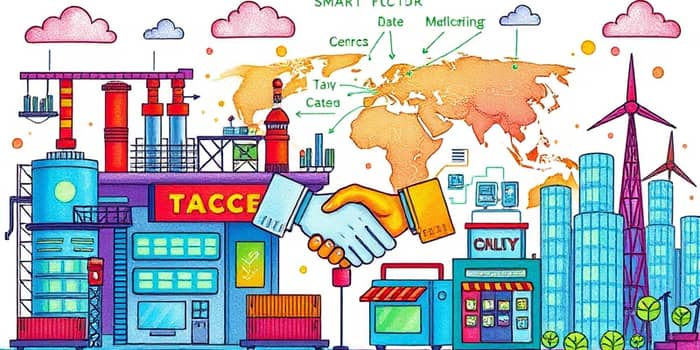
As 2026 unfolds amid cautious optimism and persistent challenges, businesses across the globe must adapt to a rapidly shifting landscape. From manufacturing floors to boardrooms, the confluence of technology, geopolitics, and sustainability is reshaping how industries compete and collaborate. This comprehensive analysis highlights the key trends defining the year ahead, offers practical strategies, and inspires leaders to harness change for growth.
The Global Economic Backdrop and Growth Projections
The world economy enters 2026 following a period of steady but subdued expansion. According to authoritative forecasts, global growth is projected global growth at 2.6% in 2026 (UNCTAD), or a modest revised up slightly to 3.3% (IMF). The United States is expected to slow to 1.5% growth for the year, while China’s economy cools to 4.6% down from five percent. Developing nations, excluding China, maintain a robust pace near 4.2%.
Global trade achieved an impressive seven percent growth to $35 trillion in 2025 but faces headwinds in 2026 as geopolitical tensions and fragmentation intensify. The OECD predicts a global GDP deceleration from 3.2% in 2025 to 2.9%, offset in part by surging AI investments. Yet the specter of a downturn looms large: J.P. Morgan places the 35% recession probability by 2026 amid stubborn inflationary pressures.
Smart Manufacturing Shapes the Future
In manufacturing, agility and digital integration are non-negotiable. A recent Deloitte survey reveals that 80% of executives plan major investments with at least 20% of their budgets directed toward smart manufacturing initiatives—automation, cloud analytics, and sensor networks. The era of traditional factories gives way to facilities where machines and data converge to optimize throughput and quality in real time.
Agentic AI, capable of making autonomous production decisions, gains traction with 22% of corporations planning 22% physical AI adoption within two years—a jump from 9% today. Reshoring accelerates under supportive U.S. policy, backed by over $500B in semiconductor commitments by 2032, aiming to triple domestic chip capacity. Simultaneously, the data center boom draws billions in funding for small modular reactors, a tenfold increase since 2023, securing energy for compute-intensive operations.
- Automation with advanced sensors and robotics
- Cloud-based analytics driving predictive maintenance
- Agentic AI making autonomous production decisions
- Workforce training aligned to emerging technologies
Reconfiguring Global Trade and Supply Chains
Trade dynamics are undergoing seismic shifts as governments leverage tariffs for strategic advantage. Tariff increases, particularly on manufactured goods, fuel a drive toward supplier diversification, nearshoring, and vertical integration. Companies are adopting digital platforms to secure end-to-end visibility and mitigate disruption risks.
Services trade now represents 27% of global commerce, growing 9% in 2025, with 56% deliverable digitally—61% in developed economies versus 16% in least developed nations. South–South trade accounts for over half of Africa’s exports, while Asia leads in high-tech shipments. Green trade gains momentum: 113 countries have pledged emission cuts by 2035, supporting a clean-tech market expected to reach $640 billion annually by 2030. Critical minerals also command attention, with mining investments rising 5% in 2024 and export controls tightening on cobalt and rare earths.
- Diversify suppliers across multiple regions
- Nearshoring to reduce transit time and risk
- Vertical integration for tighter control
- Digital platforms enhancing end-to-end visibility
Mergers, Acquisitions, and Sector Convergence
M&A activity serves as a barometer for future growth areas. In 2025, global deal values surged 36%, comprising roughly 600 deals above $1 billion. Megadeals exceeding $5 billion were led by technology (26), banking (13), and manufacturing (11), with emerging sectors like power, utilities, and pharmaceuticals gathering steam.
AI-driven transactions highlight strategic priorities: IBM acquired Confluent for $11 billion to bolster data and AI capabilities; Thermo Fisher’s $8.9 billion purchase of Clario enhances analytics for life sciences; SoftBank invested $5.4 billion in ABB’s robotics unit. Convergence is pronounced as technology firms venture into energy and healthcare, while defence spending fuels industrial partnerships. Geopolitical realignment further spurs nearshoring deals in manufacturing and logistics.
Retail and AI Investments Drive Change
The retail sector is undergoing a paradigm shift fueled by AI. Global AI spending is set to exceed $2 trillion in 2026, a 36.8% increase from 2025, with projections of 31.9% annual growth through 2029. Retailers harness AI for customer relationship management, personalization engines, chatbots, and predictive supply chain optimization.
Forward-looking organizations integrate in-store sensors, dynamic pricing algorithms, and demand forecasting tools to reduce stockouts and overstock. By leveraging AI’s analytical power, they enhance shopper experiences and streamline operations, driving both top-line growth and margin expansion.
Cross-Cutting Forces Shaping Every Sector
Beyond individual industries, several themes resonate across the economy:
- Dominance of agentic and physical AI solutions
- Geopolitical realignment reshaping trade corridors
- Sustainability as a boardroom priority
- Widening digital divide in service trade
These forces interact: AI investments spur the data center boom, while green mandates influence M&A and supply chain strategies. The digital divide underscores the need for inclusive policies to ensure broad-based benefits. Organisations that embrace technology, foster resilience, and champion sustainability will lead in this new era.
Looking Ahead: Opportunities and Risks
As businesses navigate a world of tempered growth and heightened uncertainty, strategic agility is paramount. Embrace smart manufacturing to improve efficiency, redesign supply chains for robustness, pursue targeted M&A to capture emerging opportunities, and invest in AI for competitive advantage. Simultaneously, commit to sustainable practices and foster a culture of continuous learning.
Despite a cautious economic outlook, pockets of dynamism abound—in data centers, semiconductors, clean technology, and digital services. By recognizing and responding to these trends, leaders can transform challenges into catalysts for innovation, ensuring their organisations not only survive but thrive in 2026 and beyond.
References
- https://www.deloitte.com/us/en/insights/industry/manufacturing-industrial-products/manufacturing-industry-outlook.html
- https://unctad.org/news/10-trends-shaping-global-trade-2026
- https://www.imf.org/en/publications/weo/issues/2026/01/19/world-economic-outlook-update-january-2026
- https://www.pwc.com/gx/en/services/deals/trends.html
- https://nrf.com/blog/10-trends-and-predictions-for-retail-in-2026
- https://www.jpmorgan.com/insights/global-research/outlook/market-outlook
- https://www.spglobal.com/en/research-insights/special-reports/2026-outlooks
- https://knowledge.insead.edu/responsibility/five-global-trends-business-and-society-2026
- https://kpmg.com/xx/en/our-insights/ai-and-technology/global-tech-report.html
- https://hbr.org/2026/02/9-trends-shaping-work-in-2026-and-beyond