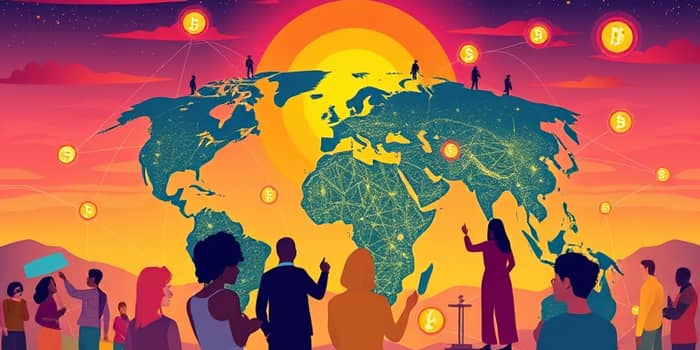
In an era defined by innovation and connectivity, cryptocurrency has emerged as a beacon of hope for millions excluded from traditional banking. From remote villages to urban centers, digital assets are rewriting the rules of engagement in the global financial system.
Across continents, a silent revolution is underway, driven by the promise of borderless financial participation and the potential to uplift those long marginalized by legacy institutions.
Historical Context and Adoption Trends
The journey of crypto began with Bitcoin’s launch in 2009, igniting a wave of experimentation and optimism. Early adopters watched values skyrocket, then plunge during volatile cycles. Yet each boom and bust left behind improved infrastructure and growing public awareness.
Today, ownership has stabilized at remarkable levels. Globally, over 560 million users held cryptocurrency in 2024, representing 6.8% of the population. Projections suggest this figure will climb to 7–8% by 2026 as education and regulation advance.
In the United States, momentum has returned after a brief dip. As of 2026, 30% of American adults—approximately 70.4 million people—own crypto, reversing the declines experienced in 2024 and aligning with peaks seen in 2022 and 2023.
Mechanisms of Change: DeFi, Tokenization, and Stablecoins
At the heart of this transformation lie decentralized finance (DeFi) platforms, tokenization protocols, and stablecoins. Together, they dismantle barriers erected by traditional intermediaries.
DeFi applications enable users to lend, borrow, and invest without banks or brokers. Since 2020, the total value locked in DeFi soared from under $100 million to over $21 billion—a staggering 300-fold increase. This growth underscores the appetite for peer-to-peer financial services that offer transparency and autonomy.
Tokenization further amplifies access by allowing investors to purchase fractional ownership and liquidity in assets once reserved for the wealthy. From real estate shares starting at five dollars to art collectibles, tokenized markets democratize wealth creation.
Stablecoins, pegged to fiat currencies like the US dollar, provide a haven during volatility and extend digital asset usability to regions with hyperinflation or unstable banking systems.
Evidence of Progress in Financial Inclusion
Perhaps the most profound impact is on the unbanked. An estimated 1.7 billion unbanked people worldwide now have a pathway to basic financial services through crypto wallets and mobile applications.
Developing regions are leading the charge. In Nigeria, nearly one-third of adults own digital currency, using it for goods, services, and cross-border remittances. Similar trends emerge in Vietnam, Turkey, and South Africa, where mobile access and community-driven education fuel adoption.
- Lowered entry barriers: no credit checks or bank accounts required.
- Remittances with minimal fees, enabling families to retain more of their funds.
- Enhanced financial security through encrypted digital wallets.
Merchant Acceptance and Mainstream Adoption
Cryptocurrency’s utility extends beyond peer exchange. In the United States, 39% of merchants accept crypto at the point-of-sale. Among large enterprises (over $500 million revenue), acceptance soars to 50%, compared to 34% of small and 32% of medium businesses.
Merchants report that crypto transactions account for 26% of their total sales, and 72% have witnessed growth directly attributable to this payment option. Furthermore, 84% predict crypto payments will become commonplace within five years.
- Faster settlements, reducing processing times from days to minutes.
- Access to new customer segments, particularly younger demographics.
- Enhanced security and privacy for buyers and sellers.
Challenges and Overcoming Barriers
Despite remarkable gains, obstacles remain. Non-owners cite concerns over unstable value, lack of protections, and cybersecurity risks. Surveys reveal that 59% of potential users doubt the safety of digital assets.
Volatility, while intrinsic to innovation, can be mitigated through stablecoins and educational initiatives that emphasize risk management. Technical barriers persist in remote areas, underscoring the need for localized apps and infrastructure investment.
- Regulatory uncertainty, which calls for advocacy and clear guidelines.
- Cybersecurity threats, addressed by stronger wallet standards.
- Volatility concerns, balanced through stablecoin adoption.
Envisioning the Future: A More Equitable Financial Ecosystem
Looking ahead, the vision of a democratized economy is within reach. Pro-crypto policies, such as the introduction of spot Bitcoin ETFs and supportive government frameworks, are driving mainstream legitimacy.
By 2026, we expect tokenization experiments to mature, DeFi protocols to integrate seamlessly with everyday financial services, and mobile platforms to empower users in every corner of the globe. This ecosystem will foster equitable wealth distribution and unlock entrepreneurial opportunities on unprecedented scales.
Education and user-friendly interfaces will be pivotal. As digital literacy improves, communities will harness blockchain for governance, cooperative fundraising, and social impact projects—reshaping finance to serve people rather than institutions.
The democratization of finance through crypto is more than a technological advance; it is a movement toward inclusive financial sovereignty and a testament to the transformative power of collective innovation.
References
- https://www.vciinstitute.com/blog/democratizing-crypto-trumps-all-making-cryptocurrency-accessible-to-everyone
- https://www.security.org/digital-security/cryptocurrency-annual-consumer-report/
- https://www.weforum.org/stories/2021/01/cryptocurrencies-are-democratising-the-financial-world-heres-how/
- https://newsroom.paypal-corp.com/2026-01-27-Crypto-Goes-Mainstream-4-in-10-US-Merchants-Accept-Digital-Assets
- https://www.brookings.edu/articles/cryptocurrencies-and-decentralized-finance-defi/
- https://www.weforum.org/stories/2026/01/digital-economy-inflection-point-what-to-expect-for-digital-assets-in-2026/
- https://www.nasdaq.com/articles/crypto-was-meant-to-democratize-finance-and-its-finally-about-to-2020-04-06
- https://www.triple-a.io/cryptocurrency-ownership-data
- https://www.klgates.com/Crypto-in-2026-The-Democratization-of-Digital-Assets-1-29-2026
- https://stoic.ai/blog/global-crypto-adoption-a-cfos-field-guide/
- https://guides.loc.gov/fintech/21st-century/cryptocurrency-blockchain
- https://www.svb.com/industry-insights/fintech/2026-crypto-outlook/
- https://www.cambridge.org/core/books/democratizing-money/bitcoin/032D820BD9271A9E0411D9EDC9664041
- https://www.mufgresearch.com/fx/fx-focus-crypto-crossroads-bitcoin-s-struggles-stablecoin-growth-and-implications-for-usd-leadership-17-february-2026/