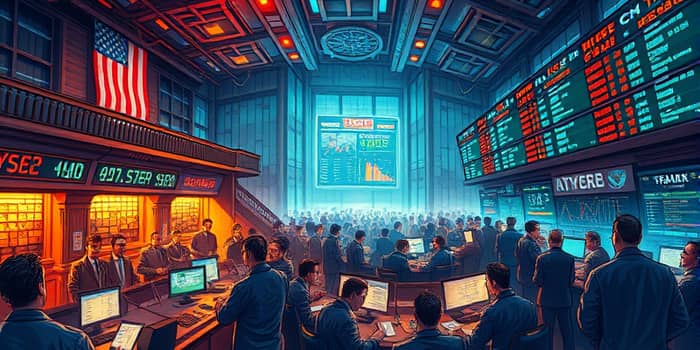
From the clamor of bustling trading floors to the silent hum of servers, the journey of global markets tells a story of relentless innovation. Across centuries, human ingenuity has reshaped how value is exchanged, birthing new systems and tools to meet the demands of risk, liquidity, and speed.
In tracing this evolution, we uncover a centuries-long saga of innovation and change that underpins every modern financial transaction. By looking back, we gain insight into the forces steering the future.
Origins of Organized Trading (17th–19th Centuries)
Long before digital screens, traders gathered in open squares and sheltered pits, calling prices in fierce competition. Amsterdam’s 17th-century bourse set a model, followed by London and Paris, where open outcry and chalkboards governed every buy and sell.
In Japan, the Dojima Rice Exchange began in 1730, marking the birth of formal futures trading with crude rice contracts. These early markets laid the groundwork for price discovery and risk management.
- Amsterdam: 17th-century stock exchange origins
- London: Open outcry and ticker tape innovations
- Dojima, Japan: Rice futures pioneer in 1730
Rise of U.S. Futures and Commodity Markets (19th–Early 20th Centuries)
By 1848, the Chicago Board of Trade (CBOT) had standardized grain contracts, taming price volatility for farmers and merchants. Full contract specifications arrived in 1865, cementing Chicago’s role as a global hub.
The New York Cotton Exchange and Chicago Produce Exchange soon followed, organizing butter, eggs, and cotton into tradeable instruments. Trading pits buzzed with energy as speculators and hedgers matched orders face-to-face.
- CBOT founded in 1848 for grain futures
- Contract standardization achieved by 1865
- NY Cotton Exchange formalized in 1872
Technological Augmentation (1950s–1970s)
The post-war era unleashed computing power onto trading floors. IBM mainframes at the NYSE automated ticker tapes and record-keeping, while teletype networks delivered quotes in minutes instead of hours.
By the late 1960s, electronic quote systems and telex networks began to reduce human latency. The launch of SuperDOT in the early 1970s routed orders electronically to exchange posts, marking a transformative electronic connectivity across global markets.
Birth of Electronic Trading (1970s–1990s)
1971 saw the debut of NASDAQ, the world’s first electronic stock market. Without a physical floor, it relied on computer networks to match bids and offers, challenging the traditional exchanges.
In parallel, rule-based algorithms propelled early trade execution. ECNs emerged in the late 1980s, allowing direct matching across multiple venues and ushering in an era of unprecedented market transparency and speed.
Algorithmic and High-Frequency Trading Era (1990s–2000s)
The rise of the internet and powerful processors enabled complex models to trade autonomously. High-frequency trading firms began executing thousands of orders per second, exploiting micro-price discrepancies.
Retail investors gained access to online platforms, democratizing market participation. The shift accelerated volatility and shrank spreads, but also sparked concerns over flash crashes and systemic risk.
- ECNs broaden multi-venue access
- NASDAQ becomes second-largest exchange
- Retail trading platforms proliferate
Modern Hybrid and Platform Dominance (2000s–Present)
Today’s exchanges blend human oversight with machine efficiency. The NYSE Hybrid Market connects floor auctions to electronic order books, while CME floors serve as backup during stress conditions.
In this era, AI-driven analytics scan vast datasets for patterns and risk signals, powering global 24/7 liquidity in markets and enhancing decision-making.
Impacts and Future Trends
The speed and accessibility of modern markets have reduced costs and unlocked new strategies. Yet increased complexity brings novel challenges in regulation, stability, and fairness.
Looking ahead, blockchain and decentralized ledgers promise blockchain-enabled decentralized trading and settlement, while quantum computing and advanced AI may redefine execution speeds and risk models.
Conclusion
From shouted hand signals in noisy pits to algorithmic orders executed in microseconds, the evolution of trading mirrors humanity’s quest for efficiency and transparency. By embracing both heritage and technology, the financial world continues to adapt, innovate, and inspire.
References
- https://verifiedinvesting.com/blogs/education/the-evolution-of-market-structure-from-trading-pits-to-algorithmic-markets
- https://algomojo.com/blog/evolution-of-algorithmic-trading/
- https://www.technologydeskingtradingdesks.com/blog/a-history-of-trading-floor-design
- https://acr-journal.com/article/advancements-in-digital-brokerage-and-algorithmic-trading-the-evolution-of-investment-platforms-in-a-data-driven-financial-ecosystem-897/
- https://edgeclear.com/from-pits-to-platforms-the-evolution-of-futures-trading/
- https://sponsored.bloomberg.com/immersive/capital/50-years-of-tech-enabled-trading
- https://eh.net/encyclopedia/a-history-of-futures-trading-in-the-united-states/
- https://my.simplertrading.com/blog/getting-started/everything-you-need-to-know-about-the-history-of-options-trading
- https://futures.stonex.com/blog/origin-and-evolution-of-the-commodity-futures-market-ii
- https://www.credinvest.ch/en/magazine/a-revolution-in-the-investment-world-the-history-of-online-trading/
- https://www.youtube.com/watch?v=cK8cPbH3wH8
- https://www.barchart.com/story/news/27194046/the-evolution-of-online-stock-trading-from-beginnings-to-blockchain
- https://www.nyse.com/history-of-nyse
- https://www.interactivebrokers.com/campus/podcasts/ibkr-podcasts/from-ancient-greece-to-daily-expirations-the-evolution-of-option-structure-and-trading-volume/