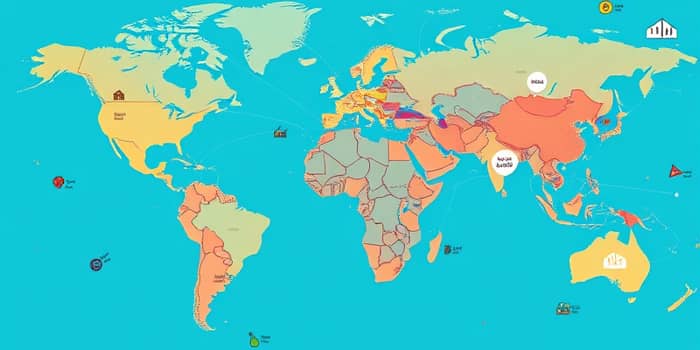
The modern economy thrives on connections. Across continents and industries, corporate ownership ties, financial flows, and strategic investments weave together an interconnected global economy that shapes prosperity and resilience.
Unveiling the Structure of Corporate Ownership
At the heart of global capital sits a vast network of more than 600,000 economic entities linked by over one million ownership ties. Transnational corporations (TNCs) headquartered in one country often hold significant stakes—at least 10%—in foreign companies, creating an intricate web of influence and resource sharing.
Remarkably, 77% of these entities belong to a single connected component, obeying a power-law distribution of component sizes. Yet within this sprawl, distinct communities emerge, defined primarily by geography rather than by industry.
These clusters highlight how capital gravitates naturally toward regional hubs, reinforcing local ecosystems while fostering transnational collaboration and competition.
The Vital Role of Financial Flows and FDI
Beyond ownership links, capital moves through foreign direct investment (FDI) and cross-border financial markets. In 2022, the United States attracted $177 billion in FDI, supporting nearly 8 million jobs at wages averaging $86,859—over 7% higher than the national average.
States like Virginia highlight this impact: over 1,000 foreign firms employ 200,000 workers, generating a payroll of $6.8 billion in Northern Virginia alone. Such investment fuels research and development, with foreign capital funding 13% of U.S. R&D spending—about $78 billion annually.
Equally transformative are spillover effects. Suppliers expand, housing markets strengthen, and entertainment and services thrive. When a new manufacturing plant opens, local communities gain far beyond the initial investment.
- Job creation and higher wages
- Innovation through cross-border collaboration
- Multiplier effects in regional economies
Barriers to Efficient Capital Allocation
Despite these benefits, frictions persist. Capital taxes, regulatory hurdles, and even cultural and linguistic differences hinder the free flow of funds. Studies estimate that such barriers reduce global output by 7%, while amplifying disparities in capital and labor productivity by up to 50.9% and 22.0%, respectively.
Home bias remains a potent force: investors allocate disproportionately to domestic assets, missing out on diversification and higher returns available abroad. Emerging economies often exhibit the greatest bias, paradoxically enjoying higher average capital returns despite constrained access.
Understanding these obstacles is crucial. Policymakers must calibrate tax regimes, harmonize regulations, and invest in language and cultural training to bridge gaps in the global financial network.
Emerging Shifts and Future Trends
The capital landscape is evolving rapidly. Traditional Western dominance faces challenges as Asia’s financial hubs—Singapore, the UAE, Malaysia—leverage reforms and strategic positioning to attract investment.
Sovereign wealth funds are reorienting domestic capital toward critical supply chains and self-sufficiency, while private equity adapts to a polycentric world. Although fundraising for smaller funds has slowed, exit activity reached $1.3 trillion in 2025, driven by robust mergers, acquisitions, and IPOs.
Impact investing also surges: assets under management have grown at a 21% CAGR over six years, reflecting rising demand for socially conscious capital deployment.
- Rise of Asia-Pacific financial centers
- Growing influence of sovereign and pension funds
- Acceleration of impact and sustainable investing
Strategies for Businesses and Policymakers
To harness the promise of global capital networks, stakeholders can adopt several practical strategies:
- Embrace strategic network engagement: Map ownership and investment ties to identify growth corridors and potential partners.
- Reduce barriers: Advocate for streamlined regulations, bilateral investment treaties, and digital platforms that simplify cross-border transactions.
- Invest in talent mobility: Foster cultural exchange programs and multilingual training to build trust and mutual understanding.
- Monitor emerging markets: Stay attuned to reforms in Asia, Africa, and the Middle East to position early in high-growth regions.
By combining data-driven network analysis with proactive policy measures, governments and firms can unlock new avenues for growth and resilience.
Conclusion
The global capital network is more than a web of transactions—it is a living ecosystem that fuels innovation, job creation, and shared prosperity. Understanding its structure, dynamics, and barriers empowers us to craft policies and strategies that maximize benefits while mitigating risks.
As emerging hubs challenge conventional power centers and digital platforms redraw the boundaries of finance, the future belongs to those who can navigate complexity with insight and collaboration. Together, we can build a more connected, efficient, and inclusive global economy.
References
- https://pmc.ncbi.nlm.nih.gov/articles/PMC4134229/
- https://www.vedp.org/news/global-capital-local-impact
- https://academic.oup.com/qje/article/140/4/3067/8171934
- https://globalcapitalnetwork.com
- https://www.jll.com/en-us/insights/market-outlook/global-capital
- https://globalcapitalnetwork.com/about/
- https://www.weforum.org/stories/2025/02/why-capital-flows-have-the-potential-to-change-the-economic-status-quo/
- https://journals.sagepub.com/doi/10.1177/0308518X231195890
- https://www.mckinsey.com/industries/private-capital/our-insights/global-private-markets-report
- https://www.jstor.org/stable/41472015
- https://thegiin.org/publication/research/state-of-the-market-2025-trends-performance-and-allocations/
- https://globalcapitalnetwork.com/terms/
- https://globalcapitalnetwork.com/investor-relations/