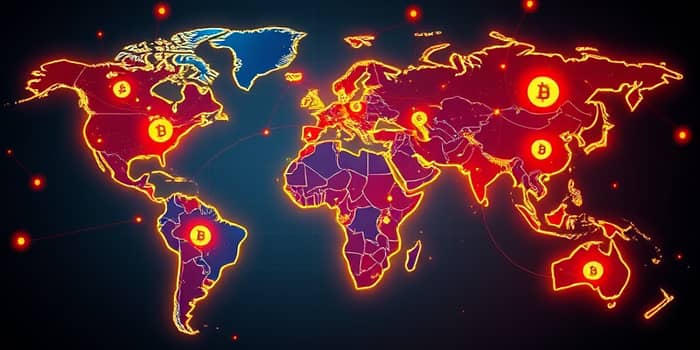
Digital currencies are no longer a fringe curiosity; they represent a transformative shift in finance that touches lives, businesses, and entire economies. From bustling Asian markets to emerging Latin American corridors, these innovations are redrawing the map of value exchange and financial inclusion.
In this article, we journey through adoption disparities, consumer sentiment, regulatory pivots, and technological breakthroughs. Whether you’re a seasoned investor or a curious newcomer, you’ll find actionable insights and inspiration to navigate this dynamic landscape.
Global Adoption Trends
Over the past decade, digital currencies have moved from niche communities into mainstream conversations. Regional patterns reveal striking contrasts in volume, utility, and user motivation. While Asia dominates trading and stablecoin flows, Latin America turns to crypto as a hedge against inflation and a tool for cross-border remittances. Meanwhile, North America charts a course through regulatory guardrails and institutional adoption.
- Asia: Leading in exchange volumes, ownership rates, and innovation hubs.
- Latin America: Embracing stablecoins for remittances and inflation protection.
- North America: Building infrastructure via regulatory clarity and spot ETFs.
Through this multipolar growth, digital currencies bridge gaps between economies and create new avenues for commerce and savings.
Consumer Sentiment and Market Growth
Consumer optimism remains high among existing owners—over half credit recent political developments for market gains, and a clear majority expect further growth in 2026. Yet barriers persist: volatility, security concerns, and the absence of deposit protections deter many potential entrants.
Market size has swelled from $2.2 trillion in 2021 to nearly $4 trillion in 2025, driven by both retail enthusiasm and institutional interest. Stablecoins account for 92% of the $24 trillion transaction volume in 2024, underscoring their central role in trading, settlements, and emerging payment rails.
Below is a snapshot of U.S. ownership trends over the past six years:
Ownership of top cryptocurrencies in 2026 highlights Bitcoin at 74%, Ethereum at 53%, Dogecoin at 25%, Solana at 20%, and USDC at 18%. Looking ahead, 61% of existing holders plan to buy more, while only 6% of non-owners intend to enter the market.
- Top planned purchases: Bitcoin (59%), Ethereum (49%), Solana (18%).
- Portfolio performance in 2026: 53% net gain, 23% breaking even.
- Persuadable middle: 47% of non-owners might consider joining later.
This dynamic environment fosters instills confidence in emerging markets and invites both caution and curiosity.
Regulatory Shifts and Policy Landscape
Between 2025 and 2026, regulators worldwide pivoted to reinforce stability and curb illicit activities. Key focuses include stablecoin frameworks, anti–money laundering (AML) controls for DeFi, and harmonized taxation on digital assets.
Major jurisdictions illustrate the trend:
North America has solidified its status as an institutional hub through clear guidelines, the launch of spot Bitcoin ETFs, and pro-crypto policy pronouncements. In Europe, MiCA (Markets in Crypto-Assets) offers a comprehensive rulebook, albeit with implementation challenges. The UAE and Gibraltar lead on institutional infrastructure, while the GCC and Saudi Arabia advance tokenized payment pilots and cross-border licensing. Globally, over 130 countries are exploring CBDCs, even if none plan to supplant cash immediately.
These developments underscore the emergence of pivotal regulatory frameworks for stability that balance innovation with consumer protection.
Emerging Technologies and Future Outlook
Beyond trading and payments, digital currency technologies are seeding innovations across industries. Tokenization of real-world assets promises enhanced liquidity for securities, real estate, and intellectual property. Blockchain solutions streamline supply chain tracking, secure digital identities in healthcare, and automate contracts through smart contracts.
Meanwhile, AI-driven fraud detection and on-chain analytics fortify security, addressing the top concern of 59% of non-owners. As DeFi platforms mature under supervised regimes, they will unlock cross-border solutions with unprecedented efficiency.
Looking ahead, we anticipate:
reimagining the future of money as CBDCs integrate with tokenized markets, DeFi scales responsibly, and stablecoins extend beyond trading into payroll, micro-payments, and remittances. Tokenized assets may shift from pilot projects to core portfolio allocations, supported by regulated marketplaces and institutional custodians.
To navigate this evolution, consider these practical steps:
- Choose regulated platforms with robust security standards.
- Diversify across asset types—cryptocurrencies, tokenized securities, and stablecoins.
- Stay informed on regulatory updates in your jurisdiction.
- Adopt wallet best practices: hardware storage, multi-factor authentication.
- Engage with reputable educational resources and community forums.
By following these guidelines, individuals and institutions can participate with confidence.
Conclusion
Digital currencies are more than technological novelties; they are catalysts for economic inclusion, innovation, and redefined financial relations. From Asia’s volume-heavy exchanges to Latin America’s utility-driven adoption, a global tapestry of use cases emerges. Regulatory frameworks are maturing, striking a balance between freedom and oversight. Meanwhile, blockchain and AI pave new paths for transparency, security, and efficiency.
As we embrace this transformation, we hold the power to shape the future of value exchange. Whether you’re investing, building applications, or remitting funds to loved ones, remember that responsible engagement, continuous learning, and community collaboration are the keys to unlocking the full potential of digital currencies. Together, we are empowering individuals and communities globally—one block at a time.
References
- https://consensus.coindesk.com/digital-asset-adoption-report/
- https://www.security.org/digital-security/cryptocurrency-annual-consumer-report/
- https://sumsub.com/blog/global-crypto-regulations/
- https://agn.org/insight/making-sense-of-cryptocurrencies-2025-2026-update/
- https://www.weforum.org/stories/2026/01/digital-economy-inflection-point-what-to-expect-for-digital-assets-in-2026/
- https://www.raininfotech.com/blockchain-trends-and-market-statistics/
- https://www.bny.com/corporate/global/en/institute/q1-global-investment-council-report.html