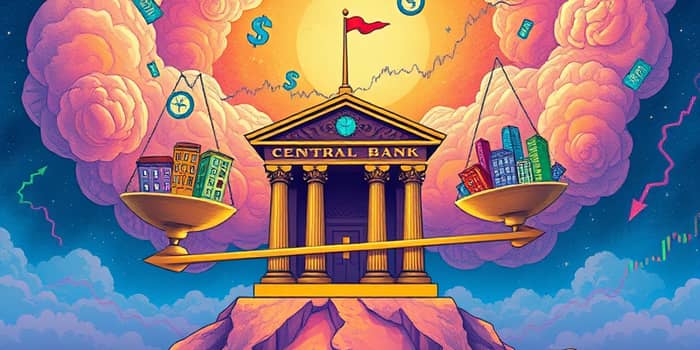
Monetary policy shapes the financial landscape more profoundly than almost any other single force.
From equity valuations to bond yields and real estate prices, central bank decisions ripple through markets, affecting investors, businesses, and households alike.
Monetary Policy: The Primary Engine of Asset Prices
Central banks, led by the Federal Reserve in the United States, use interest rate adjustments and balance-sheet operations to influence economic activity.
They often target asset prices directly to close output and inflation gaps, acting as the Monetary policy as driver of asset prices.
When the Fed cuts rates or injects liquidity, discount rates fall, risk appetite rises, and asset prices climb. Conversely, rate hikes raise real yields, tighten financial conditions, and temper valuations.
Transmission Mechanisms and Market Reactions
Understanding how policy changes flow into prices requires examining several channels:
Policy shocks differ depending on their origin. A sudden financial-market stress event—often dubbed the “Fed put”—triggers forceful intervention to stabilize prices and restore confidence. In contrast, deliberate volatility may be introduced to cool inflationary demand-supply imbalances.
- Caballero-Simsek Model (2022): Highlights noise, delays, and inertia in household spending, with optimal policy raising asset prices to offset negative shocks.
- Geromichalos Liquidity Model (2007): Emphasizes the negative inflation-asset return link and the role of money as a liquidity asset.
- Global Risk Framework: Decomposes U.S. policy surprises into pure rate, communication, and information components with spillovers to other economies.
Global Spillovers and Financial Cycles
U.S. policy shocks rarely remain contained. Through the global financial cycle, changes in Fed rates and guidance transmit to euro area and Japanese assets via risk premia channels.
Research shows that communication shocks—shifts in forward guidance—often have a larger impact abroad than pure rate moves, highlighting the transparent forward-looking policy guidance effect on international markets.
Empirical Challenges and Identification
Disentangling causality between monetary policy and asset prices is complicated by simultaneity: policy reacts to the same economic conditions that drive markets.
High-frequency identification methods exploit volatility spikes around FOMC announcements and congressional testimony days to isolate exogenous policy shocks and quantify their impact.
- Event-day heteroskedasticity: Uses sudden variance changes to pinpoint policy surprises.
- Bernanke-Kuttner approach: Infers rate expectations from futures prices and immediate stock reactions.
- Global vector autoregressions: Trace spillovers across multiple regions and asset classes.
Practical Insights for Investors and Policymakers
For market participants seeking to navigate the intersection of policy and prices, a few guiding principles emerge:
- Monitor Fed communications closely: shifts in tone often precede actual rate moves.
- Diversify across asset classes: balance duration risk in bonds with equity risk premia.
- Weather volatility with liquidity buffers: maintain cash or high-quality short-term assets.
- Adapt models to current conditions: update assumptions on inertia, frictions, and global linkages.
Policymakers, for their part, must weigh the trade-offs between stabilizing markets and allowing necessary price adjustments. Debates over a “lean-against-the-wind” approach versus passive waiting continue, with lessons from the 2006 Fed deliberations still resonating today.
Looking Ahead
As monetary authorities navigate post-pandemic recovery, inflationary pressures, and geopolitical tensions, their influence on asset prices will remain central to economic resilience.
Improvements in high-frequency data, advances in behavioral modeling, and richer cross-border analyses promise deeper insights but also underscore the persistent complexity of these relationships.
By understanding the channels, models, and empirical tools at work, investors can make more informed decisions, and policymakers can craft strategies that balance growth, stability, and financial-market health.