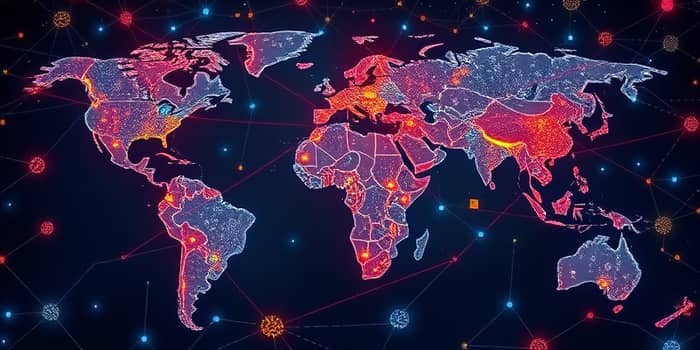
In 2026, the landscape of global finance is undergoing a profound transformation. Against a backdrop of moderated growth forecasts and mounting geopolitical tensions, capital flows are no longer driven by unfettered globalization. Instead, they align with regional resilience, technological imperatives, and climate adaptation. This article examines the forces reshaping investment patterns and offers practical guidance for navigating the new terrain.
With global growth expected to hover around 3% and advanced economies lagging, the imperative for adaptable investment frameworks and strategic capital allocation has never been more urgent. Emerging markets are projected to carry the global expansion, yet risks from currency volatility and regulatory shifts persist.
From Broad Globalization to Multipolar Networks
After decades of broad-based globalization, 2026 sees a pivot toward regional clusters and strategic realignment. Foreign direct investment (FDI) rose modestly, yet truly productive deployments fell. Organizations are:
- Prioritizing supply chain diversification for security.
- Emphasizing nearshoring to ensure continuity.
- Allocating capital based on national and regional interests.
In this climate, selective capital deployment for higher returns has become the norm. As companies seek to shield operations from cross-border shocks, resilience trumps unconstrained efficiency in boardroom decisions.
The AI and Infrastructure Revolution
At the heart of this capital cycle lies the unstoppable rise of artificial intelligence and digital infrastructure. Global spending on data centers is projected to reach $4 trillion by 2030, reflecting a data-center spending at 40% annualized growth rate. Tech giants and emerging challengers alike are racing to secure computational capacity, driving mergers, acquisitions, and greenfield projects.
“The convergence of AI, energy, and infrastructure marks one of the largest capital cycles of our era,” notes Bart Turtelboom, CEO of Delphos. Organizations that align with this wave stand to redefine global competitiveness, whether through edge computing hubs or next-generation fiber networks.
Climate Adaptation and Resilience Finance
Climate risk is no longer a peripheral concern. Over $2 trillion flows annually into adaptation measures, from flood defenses to drought-resistant agriculture. Investors are increasingly eyeing opportunities in wetlands restoration and disaster-resistant infrastructure. Meanwhile, clean energy initiatives are attracting unprecedented interest, with clean energy investments reaching unprecedented scale across wind, solar, and storage.
Yet challenges persist. Funding gaps remain acute in low-income countries, where the need for resilience is greatest. Blended finance models are bridging some divides, but public and private actors must coordinate more effectively to channel resources where they matter most.
Private Credit and Blended Finance
Traditional bank lending in frontier markets has waned, making room for private credit funds that now manage over $1.5 trillion in assets. These vehicles provide crucial financing to mid-sized firms and infrastructure developers. With assets expected to exceed $3.5 trillion by 2028, emerging markets as engines of growth find new lifelines in private capital.
Blended finance—leveraging grants, guarantees, and concessional loans—has also matured. By de-risking projects, these structures unlock scalable investments in sectors like water management and sustainable agriculture. Investors seeking both impact and yield are increasingly drawn to these innovative ecosystems.
De-Dollarization and New Payment Systems
The global financial architecture is witnessing a quiet revolution in cross-border payments. By mid-2026, three-quarters of G20 nations are slated to operate tokenized rails for trade and remittances. Led by China, India, Brazil, and Russia, these systems enable transactions in local currencies, gradually diluting the dollar’s global dominance.
Technological convergence between blockchain protocols and central bank digital currencies (CBDCs) promises faster settlement, lower costs, and enhanced transparency. Yet regulatory fragmentation and cybersecurity risks pose hurdles that market participants must navigate with care.
Protectionism, Trade Fragmentation, and Emerging Risks
Trade volumes rose to $35 trillion in 2025, but the pace is slowing. Heightened tariffs, export controls, and geopolitical standoffs are reshaping global commerce. The US has expanded tariffs on semiconductors and critical minerals, prompting retaliation and raising costs for global manufacturers.
Services trade remains resilient, buoyed by digital delivery and professional services networks. Meanwhile, South-South trade deepens, with Africa exporting more than half its goods to developing markets. Nonetheless, investors must remain vigilant; fractured supply chains and policy shifts can swiftly alter risk-return profiles.
Regional Dynamics and Opportunities
Emerging markets continue to outpace their advanced counterparts, with India set to expand at 6.7% and developing economies (ex-China) at 4.2%. A closer look at global projections highlights this divergence:
Across regions, infrastructure gaps and energy transitions offer fertile ground for investors. Key opportunities include:
- Renewable energy projects in Latin America.
- Smart grid and logistics upgrades in Asia.
- Agritech and fintech ventures in Africa.
Investor Strategies for the Evolving Landscape
In an environment of moderate global growth, capital must be deployed with precision. Managers are prioritizing resilience over pure efficiency, favoring active strategies and specialized mandates. Firms that adapt will seize the productivity frontier created by AI, clean energy, and digital transformation.
Practical steps include:
- Conducting scenario analysis for geopolitical shocks.
- Embracing blended finance to enhance risk-adjusted returns.
- Allocating to private credit for stable cash flows.
By remaining nimble and informed, investors can harness the divergences and secure sustainable returns in a complex world.
Conclusion: Navigating the New Capital Landscape
As we chart a course through 2026, it is clear that capital flows are more dynamic and localized than ever before. The intersection of AI, climate adaptation, and regional realignment heralds one of the largest capital cycles of our era. Success will belong to those who blend strategic foresight with operational agility.
Ultimately, the new paradigm demands partners who understand local contexts, collaborate across sectors, and commit to resilient outcomes. In doing so, they will not only generate returns but also help build a more secure and sustainable global economy.
References
- https://delphos.co/news/blog/global-capital-trends-2026-an-emerging-markets-outlook/
- https://www.atlanticcouncil.org/dispatches/five-trends-to-watch-in-the-global-economy-in-2026/
- https://www.mourant.com/news-and-views/news-2026/global-perspectives---january-2026.aspx
- https://unctad.org/news/10-trends-shaping-global-trade-2026
- https://www.pwc.com/us/en/about-us/newsroom/press-releases/annual-outlook-2026.html
- https://www.slaughterandmay.com/horizon-scanning/2026/capital-flows/
- https://www.jpmorgan.com/insights/global-research/outlook/market-outlook
- https://www.triodos-im.com/insights/outlook2026
- https://www.imf.org/en/publications/weo/issues/2026/01/19/world-economic-outlook-update-january-2026