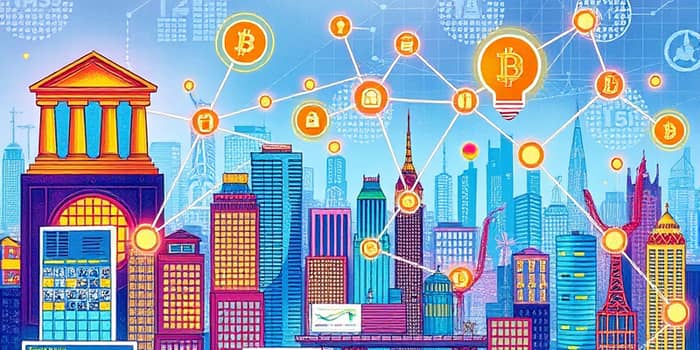
In recent years, blockchain has captured global attention as a revolutionary force in technology. While many discussions focus on speculation and headline-grabbing use cases, the true power of blockchain emerges when examining how it transforms real-world processes. By eliminating intermediaries, enhancing transparency, and automating agreements, blockchain is now making tangible impacts across diverse sectors.
From streamlining cross-border payments to guaranteeing the authenticity of pharmaceuticals, innovative organizations are harnessing these distributed ledgers to solve longstanding challenges. This article dives deep into key applications, illustrating how enterprises leverage blockchain to build resilient and efficient systems that deliver measurable benefits.
Every year, industries grapple with staggering losses. The entertainment sector alone loses $71 billion annually to fraud and IP theft, while food producers face costly delays in tracing spoilage. Blockchain offers a compelling solution by creating a single source of truth across multiple participants, slashing tracking times from weeks to seconds and preventing counterfeiting at scale.
Transforming Financial Services
The financial sector was among the earliest adopters of blockchain, driven by the promise of instant settlements with minimal counterparty risk. Traditional cross-border remittances can take days to clear and incur high fees, but blockchain platforms can process transfers in as little as 24 hours at significantly lower cost.
Major banks and consortia, including R3’s Corda network and JPMorgan Chase’s Onyx platform, collaborate to create interoperable, regulatory-compliant solutions. Visa’s B2B Connect and Ripple’s XRP network further demonstrate how blockchain enables secure, peer-to-peer transaction channels for enterprises and individuals alike.
Decentralized finance (DeFi) builds on these foundations, offering services such as lending, borrowing, and automated market making without traditional intermediaries. Protocols like Uniswap, Compound Finance, and DAI stablecoins illustrate how smart contracts can execute complex financial agreements on-chain, delivering transparent, code-driven financial instruments to anyone with an internet connection.
Enhancing Supply Chain Transparency
Supply chain management stands to gain dramatically from blockchain’s immutable and traceable records. By logging every purchase order, shipment, and quality inspection on a distributed ledger, stakeholders achieve real-time visibility from origin to consumer, reducing fraud, spoilage, and compliance risks.
IBM Food Trust has revolutionized food traceability by reducing the time to track a product from weeks to seconds in collaboration with Walmart and other retail giants. In the automotive industry, Ford and Renault partner with RCS Global and IBM to trace ethically sourced cobalt, ensuring components meet environmental and social governance standards.
- IoT sensor integration for temperature and humidity monitoring
- Supply chain finance solutions that unlock working capital for SMEs
- Regulatory compliance tracking across thousands of global standards
Securing Healthcare Data
In healthcare, patient privacy and data integrity are critical. Blockchain’s cryptographic security and decentralized architecture provide a robust framework for managing electronic health records and personal health data.
Smart contracts streamline consent management and automate data-sharing agreements between providers, insurers, and research institutions, ensuring compliance with HIPAA and GDPR. Additionally, blockchain tracks the provenance of pharmaceuticals, combating counterfeit drugs and protecting patient safety worldwide.
Organizations like Kaleido partner with the United Nations and CDC to pilot blockchain in public health initiatives, demonstrating transparent resource allocation in poverty alleviation funds and secure management of medical credentials in global clinical trials.
Empowering Digital Identity
Digital identity management suffers from fragmented systems and privacy concerns. Blockchain creates interoperable, tamper-proof identity infrastructures where users verify their credentials once and share them securely across multiple platforms.
This model reduces redundant Know Your Customer (KYC) checks, strengthens anti-fraud measures, and grants individuals greater control over personal data. Initiatives in Estonia and other nations explore blockchain-based voting systems that promise completely tamper-proof electoral processes while enhancing citizen privacy.
- One-time verification usable across financial, healthcare, and government services
- Secure biometric authentication and data sovereignty controls
- Reduced identity theft through immutable audit logs
Sustainable Energy and Beyond
Blockchain is accelerating the shift toward decentralized, renewable energy systems. Peer-to-peer marketplaces allow homeowners with solar panels to sell surplus power directly to neighbors, facilitating enhanced local microgrid resilience and reducing dependence on centralized utilities.
Smart grids leverage automated settlements via smart contracts, optimizing energy distribution and reducing waste. Crowdfunding platforms use blockchain to enable community ownership of solar and wind installations, while carbon credit tracking becomes more transparent and fraud-resistant.
Emerging projects integrate blockchain with IoT-enabled meters to provide real-time monitoring and automated billing, ensuring fair pricing and promoting sustainable consumption patterns across urban and rural communities.
Industry Adoption and Future Outlook
Across sectors, blockchain adoption varies by maturity. Supply chain logistics and financial services boast proven ROI and scalable implementations, while healthcare, government, and real estate navigate growing pilot phases to tackle regulatory and technical challenges.
As organizations seek to harness distributed ledger technology, they must prioritize interoperability, user experience, and collaborative networks. Regulatory frameworks will evolve in tandem, ensuring consumer protection without stifling innovation.
- Lower operational and transaction costs
- Faster process and settlement times
- Enhanced transparency, security, and trust
Conclusion
Blockchain has moved well beyond theoretical discussions and experimental pilots. By delivering secure, transparent, and automated solutions, it empowers organizations to overcome deep-seated inefficiencies, unlock new business models, and build trust with partners and customers.
To truly capitalize on this technology, leaders must focus on real-world use cases, foster cross-industry collaboration, and design with the end user in mind. In doing so, blockchain will continue to deliver profound, lasting value across every sector it touches.
References
- https://builtin.com/blockchain/blockchain-applications
- https://aimultiple.com/blockchain-case-studies
- https://consensys.io/blockchain-use-cases
- https://www.ulam.io/blog/exploring-blockchain-use-cases-across-industries
- https://www.geeksforgeeks.org/blogs/top-applications-of-blockchain-in-the-real-world/
- https://www.geeksforgeeks.org/machine-learning/use-cases-of-blockchain-in-different-fields/
- https://www.alibabacloud.com/en/knowledge/five-application-scenarios-of-blockchain-technology?_p_lc=1
- https://blockchaintechnology-news.com/news/7-industry-giants-using-blockchain-to-improve-business-operations/
- https://www.youtube.com/watch?v=gKA1mzajwyA
- https://www.casper.network/get-started/a-brief-guide-to-industries-using-blockchain-technology
- https://aws.amazon.com/what-is/blockchain/
- https://connectbit.com/blockchain-applications/
- https://www.casper.network/get-started/24-top-enterprise-blockchain-applications
- https://www.itransition.com/blockchain/retail